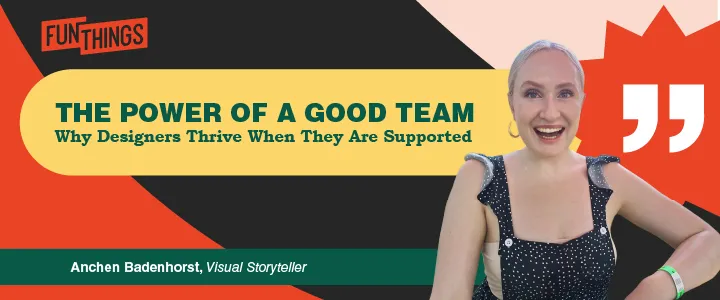
There is a persistent myth that designers work best alone, tucked away with a sketchbook or screen until inspiration strikes. But anyone who has spent time in a modern creative environment knows the opposite is true. Good design flourishes in supportive teams, in environments where encouragement, trust, and collaboration shape the work as much as the tools we use.
Strong design is never created in isolation. It is shaped by the people around it.
A supportive team creates space for ideas to grow. It turns first drafts into better drafts. It transforms uncertainty into exploration. When peers and leaders provide guidance instead of pressure, curiosity instead of criticism, and collaboration instead of hierarchy, the creative process becomes richer and more sustainable.
Support Shows Up in Small Moments
Support in a design team often shows up in small moments:
- A colleague who says, "this direction has potential, keep going"
- A project manager who gives breathing room for refinement
- Healthy discussions where ideas can be challenged without ego
- Leaders who trust the creative process, even when the early stages look messy
These interactions form the backbone of meaningful work. They give designers the freedom to take risks, experiment, and learn without fear of missteps. They help the team stay aligned without shutting down imagination. Most importantly, they create a culture where people feel motivated to bring their best ideas forward.
Because a supportive team is not just a positive environment. It is a creative tool.
The Connection Between Support and Creativity
Designers draw inspiration from emotion, observation, and shared experience. When a team values open communication, diverse perspectives, and thoughtful feedback, the work becomes more nuanced. When a team is rushed, reactive, or dismissive, the work becomes restrained. Good teams understand that creativity takes time — not silence or isolation, but time spent thinking, talking, refining, and coming back with something better.
Support fuels creativity. Pressure restricts it.
And in teams where designers feel understood and backed by their peers, something powerful happens:
- Ideas flow more naturally
- Solutions become more thoughtful
- Problem solving becomes collaborative
- Creativity becomes a shared responsibility
This creates not only better design, but better designers. A healthy creative environment becomes its own form of mentorship, where every project becomes an opportunity to learn from the people working alongside you.
Knowing When to Step Back
Great teams also know when to step back. They trust designers to explore, test, and iterate. They understand that not every idea is born polished — and that the messy middle is where breakthroughs often hide. Encouragement at the right moment can move a project forward just as effectively as critique.
Creativity as a Collective Effort
Ultimately, the strongest design teams are those that recognise creativity as a collective effort. They understand that every idea passes through many hands, shaped by many minds, influenced by many perspectives. They know that when designers feel safe, heard, and supported, the final work is not only stronger, but more human.
Good design is built on many things: research, strategy, skill, intuition. But it is sustained by one thing above all else: the people who stand behind it.